One-page multilingual table
Taiwanese numeral comparison
Text in any language deserves the same precision. This historical table brings Japanese annotations, Taiwanese language data, and Latin diacritics together as editable text.
Historical terminology is preserved.
Highlighted features
Mixed scripts and combining marks
Locally bundled Noto Serif CJK JP and Charis fonts cover the Japanese text, Roman transcriptions, and tone marks. UTF-8 source preserves the authored combining sequences without replacing them with look-alike marks.
Vertical labels in a spanning table
A fixed-layout HTML table uses real row spans for its nested language groups. writing-mode: vertical-rl and text-orientation: upright turn only the group labels, keeping the numeral data horizontal.
Native page footnotes
float: footnote moves the original explanatory note from its first asterisk to the page's @footnote area. Custom footnote calls and markers retain the historical notation without repeating the note body.
One table, many languages
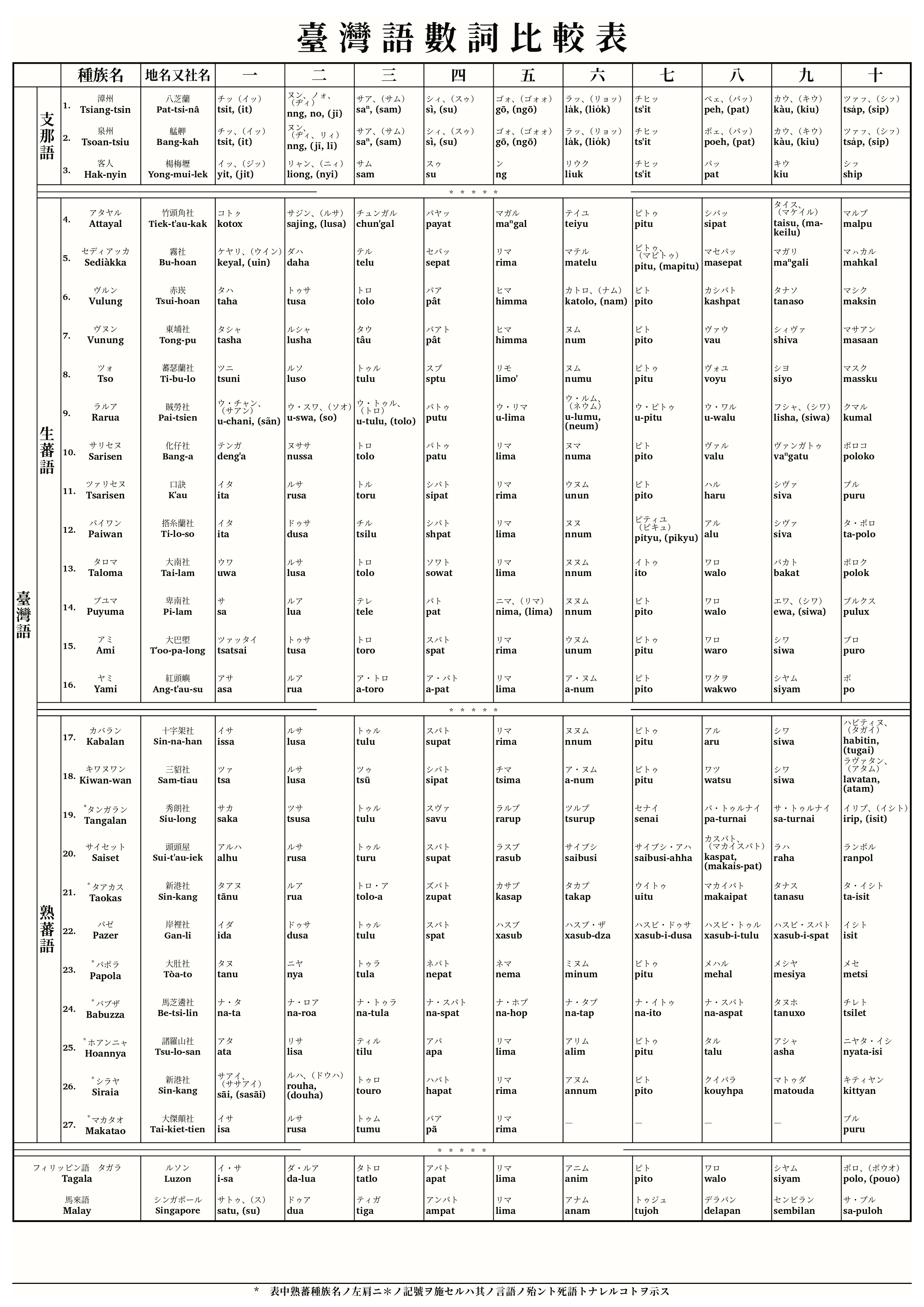
臺灣語數詞比較表 compares the words for one through ten across languages and local varieties of Taiwan, followed by Tagalog and Malay. It comes from Naoyoshi Ogawa's (小川尚義) 日臺大辭典 (Nitai Daijiten), published in March 1907. Taiwan's National Library identifies the compiler, publication date, and the comparison table in its introduction. The reference scan shared on r/taiwan guided this recreation.
The table includes Sinitic varieties and Indigenous Taiwanese languages. Its 27 numbered records represent historical entries and local varieties, rather than 27 distinct languages under modern classifications. Two further rows compare Tagalog and Malay.
Repeated forms are easy to spot: lima for five and pitu for seven recur across several entries. These comparisons offer a glimpse of the relationships within the Austronesian family. Taiwan's Indigenous languages are particularly important to research into that family's origins; Wikipedia's Formosan languages article provides an introduction.
The Japanese kana and Roman transcriptions give parallel representations of pronunciation. Tone marks, including the combining vertical line in la̍k, and the superscript ⁿ in saⁿ, are part of the linguistic content. Preserving these details matters just as much as aligning the table.
Recreating the historical layout
This is an editable HTML and CSS recreation, with bundled replacement fonts. The Japanese title, historical names, grouping labels, comparison rows, and footnote retain the source's presentation. The scan is not embedded in the PDF or included in the source download.
The original footnote says that an asterisk identifies languages the author regarded as nearly extinct. That is a historical assessment, not a statement of their status today. The colonial group names remain part of the recreated source; the surrounding explanation uses modern terminology.
A real fourteen-column HTML table gives the language names, places, and ten numeral columns stable widths. Row spans carry the nested group labels across the relevant records. Those labels use writing-mode: vertical-rl and text-orientation: upright; the rest of the table keeps its horizontal flow. Row headers and explicit headers associations describe how the cells relate.
The first asterisk calls a float: footnote. Its body flows into the @page footnote area, where a short rule separates it from the table. Later asterisks reuse the notation without duplicating the explanatory text.
Adapt the text and fonts
The source uses UTF-8 throughout. lang="ja" identifies the historical Japanese document; und-Latn identifies Latin transcriptions whose modern language identification is not asserted. For a new document, use language tags appropriate to its content and fonts suited to its script and regional glyph forms.
Noto Serif CJK JP 2.003 supplies the Japanese text, and Charis 7.000 supplies the Latin transcriptions. Both regular and bold faces are declared with their actual weights. The complete, unmodified font files and their SIL Open Font License notices are bundled, so rendering needs no network access or installed fonts. The README explains how to reuse this approach for other languages.
<wbr> provides deliberate break opportunities before alternate kana forms. The CSS Text Level 4 draft's wrap-inside: avoid prefers keeping each parenthetical form together. Cell content remains visible, and rows can grow to accommodate wrapped text.
Generate the PDF
Extract the source ZIP, keep taiwanese-numerals.html, taiwanese-numerals.css, and fonts/ together, and run from that directory.
precisionpdf taiwanese-numerals.html taiwanese-numerals.pdffrom precisionpdf import HTML
HTML(filename="taiwanese-numerals.html").write_pdf("taiwanese-numerals.pdf")