Historic Senate report
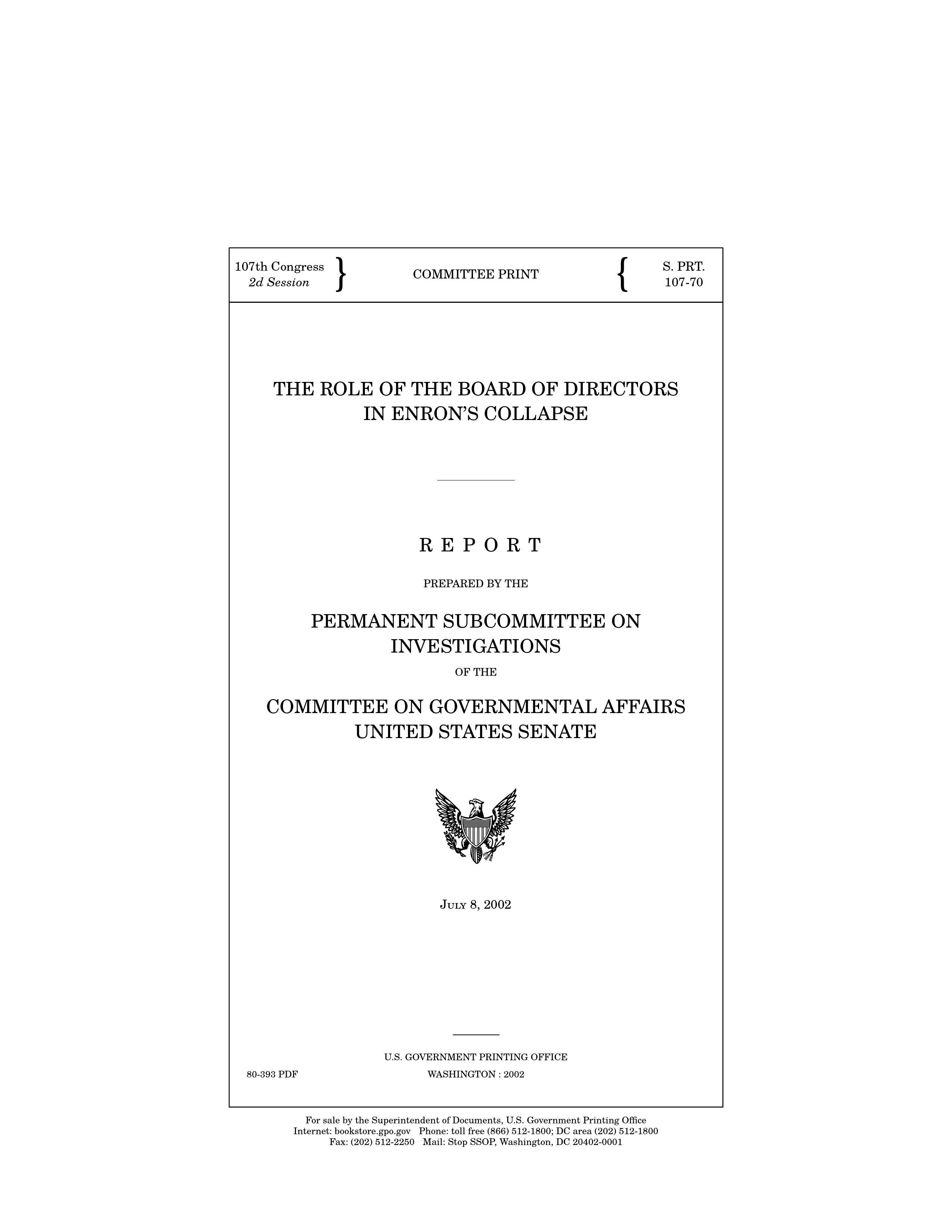
Enron board report
The Senate's investigation into Enron's board includes Sherron Watkins’ August 15, 2001 warning memo to Kenneth Lay in Appendix 2, one of the case's defining documents. This sample recreates the July 8, 2002 report in HTML and CSS, including the original memo scans.
Recreated from the historical report. The text reflows, so pagination differs from the original government publication.
Highlighted features
192 automatically numbered footnotes
float: footnote places notes below the text. The footnote counter generates superscript calls and markers; @footnote provides the separator rule. Calls link to their notes, and note numbers link back. Every note begins on its call's page, with long notes allowed to continue.
Contents with automatic page references
Contents links combine leader() with target-counter() to generate dotted leaders and destination folios. Internal appendix references update through the same page counters.
Roman and Arabic page numbering
Named @page rules give the front matter Roman folios and restart the report at Arabic page 1. Margin boxes position the folios, while :blank rules keep the blank verso unnumbered.
A historical investigation
The Role of the Board of Directors in Enron's Collapse, S. Prt. 107-70, was prepared by the U.S. Senate Permanent Subcommittee on Investigations on July 8, 2002. It examines the board's oversight of the accounting practices, conflicts of interest, and financial arrangements behind Enron's collapse. Appendix 2 includes Sherron Watkins’ August 15, 2001 warning memo to Kenneth Lay, one of the case's defining documents.
The original government publication is available from the U.S. Government Publishing Office. This recreation preserves the historical wording and eight original appendix scans, with editable HTML for the main text. It contains 73 Letter pages, compared with 67 in the original. TeX Gyre Schola substitutes for the original New Century Schoolbook; line breaks and pagination differ. The authentication stamp, highlight, and printer job-information footer are omitted.
How the footnotes work
All 192 notes live alongside their calls in the HTML and use float: footnote. The document-wide footnote counter supplies the numbers through ::footnote-call and ::footnote-marker. A named report page defines an @footnote area with a short separator rule, and the notes use compact 7pt type.
PrecisionPDF automatically links each superscript call to the beginning of its note and each note number back to its call. The links follow the generated pagination, including notes that continue across pages. This PDF navigation is a renderer feature; the current CSS footnote draft defines layout and numbering without requiring hyperlinks. No additional HTML links or experimental CSS are needed.
footnote-policy: line asks the renderer to begin a note on the page containing its call. All 192 notes do so in this PDF. Long notes can continue onto the next page, keeping their text in order beneath a repeated separator. The calls, note bodies, numbering, and continuations have been checked for completeness and layout.
How the page references work
The contents uses leader() for dotted leaders and target-counter() for destination page numbers. Appendix references within footnotes use the same mechanism. These references follow the generated pagination instead of copying the original report's page numbers.
Named @page rules distinguish the cover, roster, contents, report, and appendices. Margin boxes generate Roman front-matter folios and Arabic report folios. The report begins on a right-hand page, restarts at 1, and places its first folio at the bottom. Blank-page rules suppress the folio on the intervening verso.
Generate the PDF
Extract the source ZIP, keep report.html, report.css, fonts/, and images/ together, and run from that directory. All fonts and images are bundled for offline rendering.
precisionpdf report.html report.pdffrom precisionpdf import HTML
HTML(filename="report.html").write_pdf("report.pdf")